
September 5, 2026 · Adam Boyer
Is Wing Chun Effective for Self-Defense?
Wing Chun is built for close-range civilian defense, but results depend on how a school trains — not the style name. What forms and sticky hands do, what they don’t, and how to see if it fits.
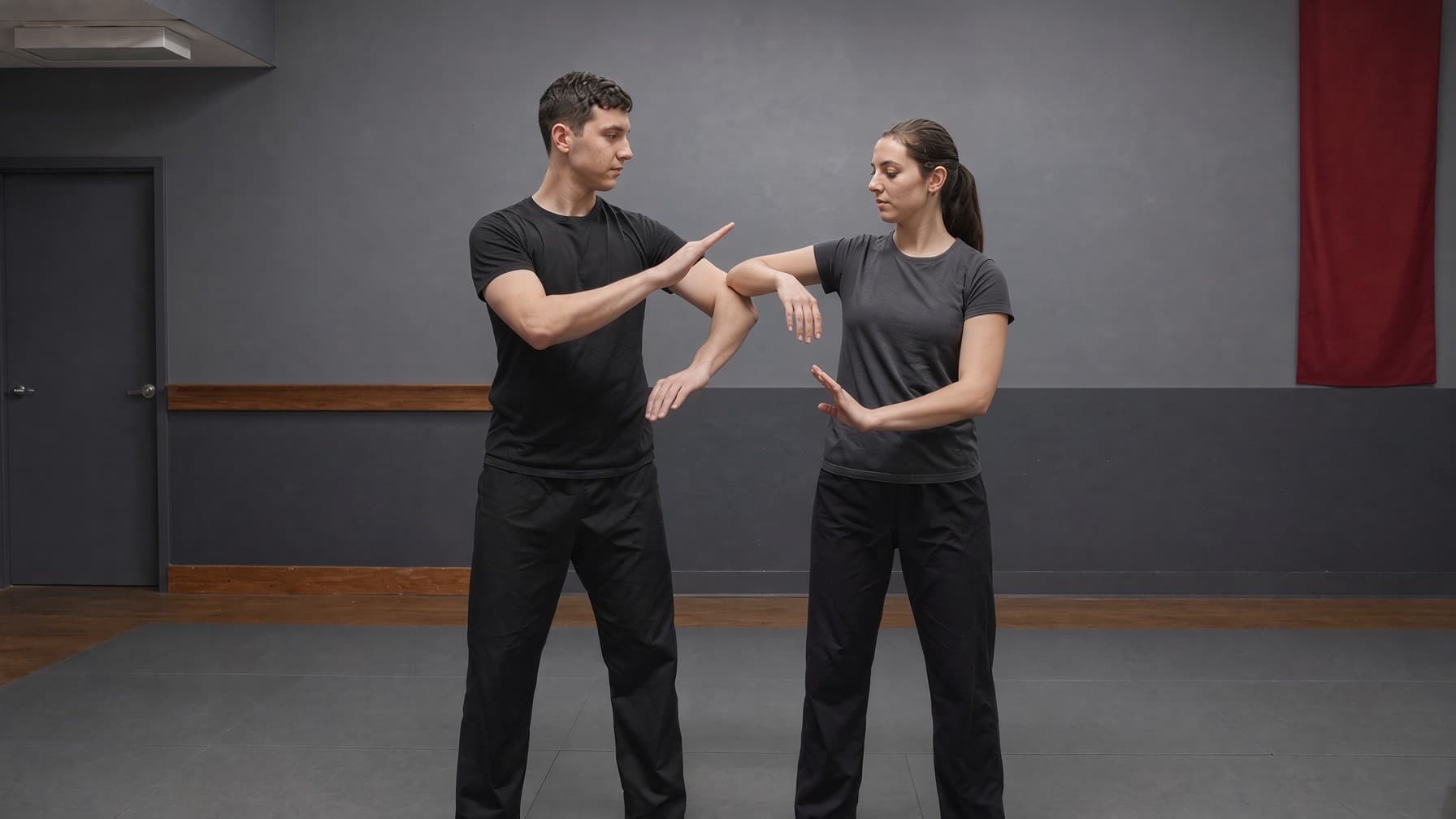
Two adults practicing calm close-range Wing Chun sticky hands in a training hall
Is Wing Chun Effective for Self-Defense?
Adults who watch an Ip Man clip or movie usually ask a blunt question: is Wing Chun effective for self-defense, or is it movie choreography and sticky hands?
Wing Chun is a close-range Southern Chinese system. Historians and standard references describe it as built around economy of motion, centerline control, simultaneous attack and defense, and tactile sensitivity (Judkins, 2015/2019). That design aims at the hand-range of common problems — conversational distance, where a long kicking game or sport-rules exchange often never gets room to start.
Effectiveness still depends on how it is trained, not on the name of the style. Motor-learning research has long shown that practice is specific: you get good at what you repeatedly do under the conditions you practice it (Proteau, Marteniuk & Lévesque, 1992). Two schools can share a label and produce very different students. One treats forms and cooperative drills as the whole product. Another uses those tools as a foundation, then adds partner work that gets less cooperative over time, with clear consent and control. When people say “Wing Chun doesn’t work,” they are often describing what they have seen on YouTube or social media — a brand-new student, a rough early clip, or one narrow kind of training. That is not a fair verdict on the design itself.
What the System Is Built to Do
Typical Wing Chun training includes short-range hand work, trapping and sensitivity, structure over bulk, the three empty-hand forms, and low kicks. Schools talk about taking the shortest line to the center, using structure instead of muscling through, and answering an attack while you meet it.
None of that means “one technique ends any confrontation.” It means the art was aimed at close-range civilian defense, not sport scoring. Close range is where a lot of adult trouble actually happens. Design is not a guarantee that any given class will prepare you for a messy problem outside the room.
Structure still matters mechanically. In a small lab study of Wing Chun straight punches, impulse tracked how much effective mass was behind the hit more than hand speed alone (Abazari, Ehsani & Rostami, 2016). That is a force-plate finding, not street proof — useful for why class emphasizes structure and conditioning, not a claim that you need to be athletic to start.
Forms, Sticky Hands, and What They Are For
Forms like Siu Nim Tao are practiced and repeated. Relaxed, consistent repetition helps build structure and usable movement patterns in the arms and body. That foundation matters. Forms do not teach fighting or self-defense by themselves. They prepare the body so partner work and application have something solid to stand on — which fits the specificity idea above: solo practice encodes what you practice, not a full resisting opponent.
Chi sao (sticky hands) is a contact drill. It builds sensitivity: feeling pressure, spoiling an arm, staying connected when someone tries to blast through your center. It is a useful start. Chi sao usually begins from linked arms. A real problem does not. Treating sticky hands as the whole answer to self-defense is using one tool as if it were the toolbox.
Reviews of combat skill treat skilled exchange as an interactive problem: two people co-adapting, not a solo technique list (Krabben, Orth & van der Kamp, 2019). Related work on elite athletes has shown that even hard training can under-simulate real pressure — and behavior then changes (Maloney et al., 2018). Those studies are not Wing Chun street trials. They support a method claim only: if practice never includes representative interaction and pressure, transfer stays limited.
Training that mixes cooperative patterns with less-cooperative partner work — under clear coaching, and with intensity that grows as people are ready — gives the body more useful content for the unexpected. No training fully replicates a hostile situation. Partner work that gradually adds resistance and variability still helps a practitioner prepare better than forms alone.
Honest Limits
One hour a week is training, not a finished skill. Even serious athletes find that how training is designed changes what shows up under pressure — so consistency and method both matter. Wing Chun can be practical for self-defense when practice is consistent and the method stays close-range and usable — not because the name guarantees anything.
Beginners and Athletic People
If you are new: You do not need prior martial arts experience. Early classes are about stance, basic hands, how class flows, and controlled partner work. Intensity should grow with skill and training goals, not ego.
If you already train or play sports: Expect structure, centerline work, and close-range partner drills — not a cardio class with a Kung Fu label. Athleticism helps; it does not replace timing and position.
See for Yourself
Want to know if Wing Chun is a good fit? Come try a class, or watch how one trains. Register or request info when you are ready.
Akron Wing Chun Kung Fu meets Tuesdays, 6–7 pm, at the St. Luke’s Church Youth Building, 3810 Ridgewood Rd, Copley, OH. Ages 13+, all levels welcome. We train fundamentals and partner drills; intensity grows with readiness and each person’s training goals.
Related reading:
- What Is Wing Chun?
- Your First Class at St. Luke’s in Copley
- Wing Chun Self-Defense for Teens and Adults
Sources (selected)
- Judkins, B. N. (2015/2019). The Creation of Wing Chun / Kung Fu Tea summary on history and transmission.
- Proteau, L., Marteniuk, R. G., & Lévesque, L. (1992). A sensorimotor basis for motor learning. Quarterly Journal of Experimental Psychology A. https://doi.org/10.1080/14640749208401298
- Krabben, K., Orth, D., & van der Kamp, J. (2019). Combat as an interpersonal synergy. Sports Medicine. https://doi.org/10.1007/s40279-019-01173-y
- Maloney, M. A., et al. (2018). Taekwondo fighting in training does not simulate the affective and cognitive demands of competition. Frontiers in Psychology. https://doi.org/10.3389/fpsyg.2018.00025
- Abazari, R., Ehsani, H., & Rostami, M. (2016). Effective mass and impulse in Wing Chun straight punches (lab sample). ICBME. https://doi.org/10.1109/icbme.2016.7890976
Ready to train in Copley?
Tuesday 6:00–7:00 pm · Ages 13+ · St. Luke’s Youth Building
Register for Wing Chun →